
Investment Reporting and Dashboards for Nonprofits and Associations
Investment reporting for nonprofits and associations should tie portfolio results back to the objectives and guidelines outlined in your Investment Policy Statement. That means structuring monthly dashboards, quarterly governance reports, and daily portal access around your policies so your committee can focus on whether the investment program is operating as intended.
How Investment Reporting and Dashboards Support Nonprofit Governance

Nonprofit and association finance committees and investment committees rely on investment reporting and dashboard access to fulfill their fiduciary oversight responsibilities. Reporting should connect portfolio results to the benchmarks, allocation targets, and policy guidelines defined in your Investment Policy Statement (IPS). When reporting is structured around your IPS, your committee can ground its governance discussions in whether the investment program is operating as intended and whether performance is in line with expectations. This is especially important for organizations with volunteer committees, where clear, policy-driven reporting helps new members get up to speed and contribute to informed discussions more quickly.
We structure reporting and dashboard access around your policies so investment performance reviews reflect the context that matters to your organization.
What Raffa's Nonprofit Investment Reporting Includes
Our nonprofit and association investment reporting gives your finance committee, investment committee, and staff visibility into your investment program through monthly dashboards, quarterly governance and performance evaluation reports, daily portal access, and proactive market updates. Together, these provide your committee with ongoing oversight between meetings and the detail needed to support informed discussions when you convene.
Monthly Investment Dashboard
Quarterly Performance Report
Online Client Portal
Market and Economic Updates
How Investment Reporting Supports Nonprofit Finance Committee Oversight
Nonprofit and association finance committees have specific reporting expectations that differ from individual or corporate investors. Committee members are typically volunteers with limited time to review investment materials, and reporting should be structured to help them fulfill their fiduciary oversight responsibilities efficiently. While every committee will have its own priorities, these are some of the core questions your nonprofit investment reporting should help your committee answer.
Is Our Portfolio in Compliance with Our Investment Policy?
Nonprofit and association finance committees have a fiduciary responsibility to confirm that the investment portfolio is operating within the guidelines established in the IPS. Your monthly dashboard and quarterly governance and performance evaluation report should show asset allocation relative to target ranges and tolerance bands, and performance relative to policy benchmarks. This allows your committee to verify compliance without needing to interpret raw data.
Is Performance Tracking as Expected Relative to Our Benchmarks?
Investment performance for nonprofits and associations should be evaluated relative to the benchmarks established in your IPS. Your committee should be able to see how each asset class and the total portfolio performed against its policy benchmark over multiple time periods, evaluated in the context of the portfolio’s allocation, time horizon, and the role each reserve pool is intended to play. A single quarter of underperformance does not necessarily indicate a problem, just as a single quarter of outperformance does not necessarily indicate success. The goal is to understand whether results are consistent with the investment approach your committee has approved.
How Has Our Portfolio Grown Relative to What We Have Invested?
Understanding the relationship between what your organization has contributed to the portfolio and how those funds have grown over time is a core component of long-term oversight. Your reporting should show portfolio value alongside cumulative net contributions so your committee can clearly distinguish between growth driven by investment results and growth driven by new capital.
What Has Changed in Our Portfolio Since the Last Meeting?
Between committee meetings, contributions, withdrawals, income, and market movements all affect portfolio value. Your monthly dashboard and quarterly report should provide a clear activity summary so your committee can see how the portfolio moved from one period to the next and understand what drove the change.
Raffa Insights & Resources
Created for the Nonprofit and Association Community

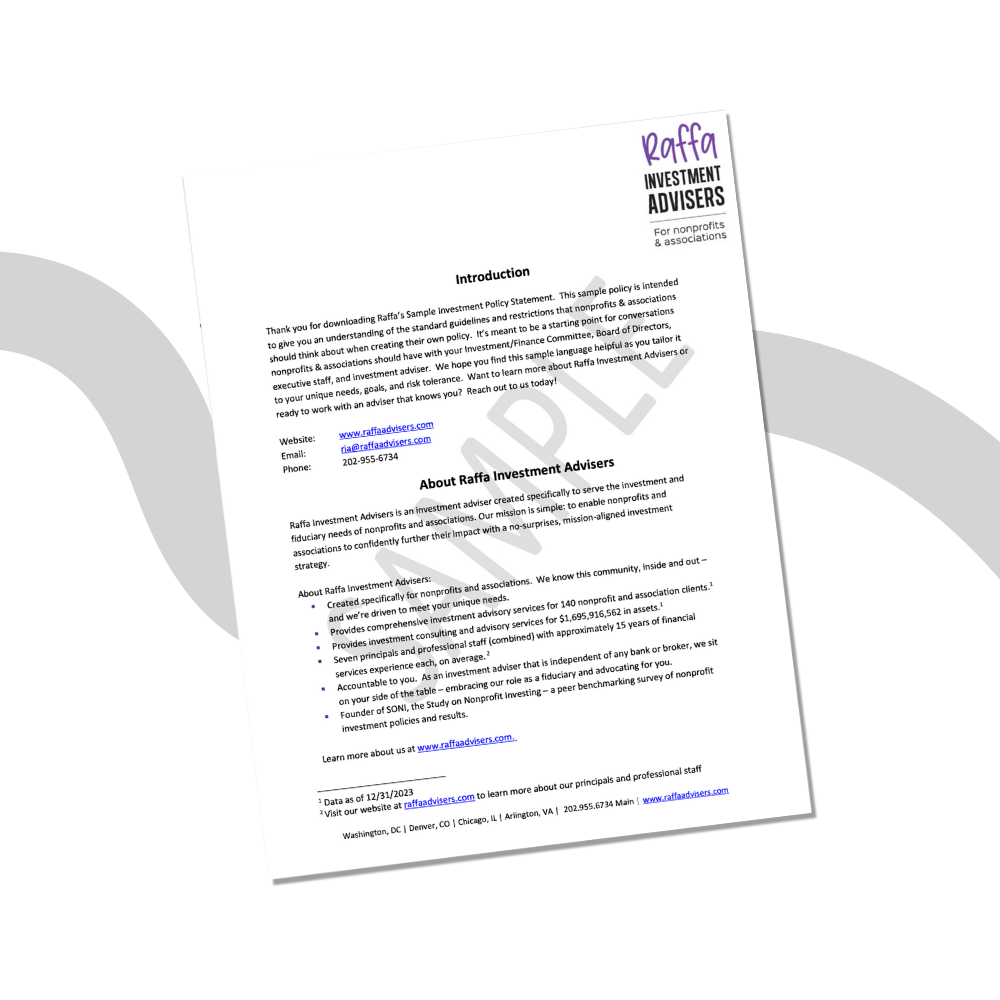

Nonprofit & Association Investment Reporting FAQs
What should nonprofit or association investment reporting include?
At a minimum, nonprofit and association investment reporting should include portfolio performance relative to policy benchmarks, asset allocation compared to targets and tolerance bands, an activity summary showing contributions, withdrawals, income, and market changes, and relevant context to support committee discussion. Reporting should be structured to support fiduciary oversight, not just summarize returns. Raffa Investment Advisers uses a combination of a monthly summary for staff visibility between meetings and a more detailed quarterly report designed for committee or board-level review.
How often should a nonprofit or association review its investment performance?
We recommend that nonprofit and association finance committees review investment performance on a quarterly basis at minimum, typically in conjunction with a board or committee meeting. Monthly reporting can provide staff and committee members with visibility between meetings so that questions or concerns can be identified early. The cadence that works best depends on your organization’s governance structure and the complexity of your investment program, but quarterly review is widely considered a baseline for fulfilling fiduciary oversight responsibilities.
How should a finance committee evaluate Performance?
Performance should be evaluated relative to the benchmarks and allocation targets defined in your Investment Policy Statement (IPS), not just absolute returns or broad market indexes. Key questions include whether the portfolio is aligned with its intended structure, whether performance is consistent with expectations given the allocation, and whether any deviations are understood and acceptable. Evaluating performance over multiple time periods helps your committee distinguish between short-term fluctuations and longer-term trends. A single quarter of underperformance does not necessarily indicate a problem, just as a single quarter of outperformance does not necessarily indicate success.
A well-constructed benchmark serves as a stable, neutral reference point for evaluating whether the decisions being made within the portfolio are adding value over time. Benchmarks are typically built using market indexes that correspond to each asset class in your allocation. The most useful benchmarks are simple, clearly aligned with your portfolio’s structure, and consistent over time. Peer benchmarking can provide additional context by comparing your organization’s reserve levels, allocation, and other financial metrics against similar nonprofits and associations.
What are investment benchmarks and how should a nonprofit evaluate them?
Investment benchmarks are market indexes used to evaluate whether a portfolio is performing as expected. For nonprofits and associations, benchmarks should reflect the target allocation and investment approach defined in your Investment Policy Statement. They are typically constructed by matching an appropriate index to each asset class in your portfolio, creating a neutral reference point for measuring whether active decisions are adding value over time.
Not all indexes are equally representative. The strongest nonprofit investment benchmarks use broad, widely recognized indexes that capture the full scope of an asset class, providing a more comprehensive view of market performance than narrower or less established indexes that may only reflect a subset of the market. Your committee should understand why each benchmark was selected and whether it provides a fair and comprehensive basis for comparison. If benchmarks are narrow, unfamiliar, or change frequently, your committee should ask your advisor to explain the reasoning. These are reasonable and important questions as part of your fiduciary oversight responsibilities.
How does investment reporting connect to our reserve strategy and Investment Policy Statement?
Your Investment Policy Statement defines how your portfolio should be structured and what benchmarks and guidelines apply. Your reserve strategy defines how your organization’s total reserves are categorized by purpose. Investment reporting tracks whether each reserve pool is performing in line with its policy guidelines. When these three elements are coordinated, your finance committee has a complete picture of how your reserves are structured, managed, and performing. If reporting is not organized around your IPS and reserve structure, it becomes harder for your committee to evaluate whether the investment program is operating as intended.
What is the role of a nonprofit finance committee in investment oversight?
A nonprofit or association finance committee is responsible for overseeing the organization’s investment program as part of its broader fiduciary duties. This typically includes reviewing investment performance, confirming that the portfolio is operating within the guidelines established in the IPS, evaluating whether the current investment approach still reflects the organization’s circumstances, and reporting to the board. Many organizations delegate this oversight to a dedicated investment committee. Regardless of structure, the committee’s role is to provide informed supervision, not to make individual investment decisions.
Investment Management & Reporting Designed for Nonprofits
Disclosures:
This material is provided for informational and educational purposes only and is intended to support general understanding of nonprofit and association investment reporting and governance considerations. It is not intended as, and should not be relied upon as, investment, legal, or tax advice, or as a recommendation or solicitation to buy, sell, or hold any security or to adopt any specific investment strategy.
The information presented is general in nature and does not take into account the specific objectives, financial circumstances, liquidity needs, or risk tolerance of any particular organization. Each nonprofit or association should evaluate its own situation and governing policies when assessing investment reporting, performance, or oversight practices.
All investments involve risk, including the possible loss of principal. There can be no assurance that any investment strategy, portfolio structure, or reporting framework will achieve its objectives or that investment results will align with expectations, benchmarks, or historical patterns.
Any references to monitoring, reporting, dashboard access, or evaluation relative to benchmarks or Investment Policy Statement (IPS) guidelines are intended to describe general processes and considerations. These processes are designed to support oversight and evaluation, but they do not ensure that investment portfolios will remain in compliance with policy guidelines or that performance will meet expectations.
References to performance, benchmarking, or comparisons to market indexes are provided for informational purposes only and do not imply that any investment approach will generate returns, outperform benchmarks, or add value over time. Performance outcomes will vary based on market conditions, economic developments, interest rates, and other factors.
Descriptions of reporting deliverables, dashboards, data availability, or portfolio visibility are intended to illustrate general service features and do not guarantee completeness, accuracy, or sufficiency of information for any particular decision-making purpose. Reporting is one component of a broader governance process and should be considered in conjunction with other information, professional advice, and organizational judgment.
Any examples, descriptions, or illustrations of reporting structures, benchmark construction, or evaluation methods are general in nature and may vary depending on an organization’s specific investment program, governance structure, and Investment Policy Statement.
Raffa Wealth Management, LLC, doing business as Raffa Investment Advisers, is an SEC‑registered investment adviser. Registration does not imply a certain level of skill or training. Advisory services are provided only pursuant to a written agreement. Additional information about the firm, including its services, fees, and conflicts of interest, is available in its Form ADV Part 2, which can be obtained upon request or by visiting https://www.adviserinfo.sec.gov.