
Investment Policy Development for Nonprofits and Associations
Your Investment Policy Statement (IPS) is only as strong as the process used to build it.
It should be a framework your board can govern against, not just a document on file.
Why Your Investment Policy Statement Matters
Board members rotate. Committee priorities shift. Market conditions change. Through it all, your Investment Policy Statement should provide a consistent framework for how your organization’s reserves are managed and overseen.
Your Investment Policy Statement is the foundation of your nonprofit’s investment program. It sets the guidelines, defines the objectives, and provides the framework that assists your board and committee in making informed decisions. Since 2005, we have worked with nonprofits and associations to create and refine Investment Policy Statements that are aligned with organizational goals and built to support sound decision-making over time. Our refined process is collaborative and designed to work within your governance structure.
Nonprofit and Association Governance Policy Resources:
Sample Reserve Policy | Sample Investment Policy Statement | Governance Policy Guide
An Effective Investment Policy Statement Includes:
A well-designed Investment Policy Statement gives your board and committee a shared framework for managing your organization’s reserves. It defines how decisions are made, who is responsible for what, and how success is measured. While every IPS is tailored to the organization it serves, an effective policy typically addresses the following areas. We work with your team to address each of these in depth, resulting in a policy document that your current and future board members can understand, implement, and use to fulfill their fiduciary oversight responsibilities.
Investment Objectives & Risk Tolerance
Reserve Policy and Segmentation
Asset Allocation Guidelines
Roles & Responsibilities
Permitted & Restricted Investments
Performance Benchmarks
Raffa Insights & Resources
Spending Policy Guidelines
Regular Review & Amendment of Procedures
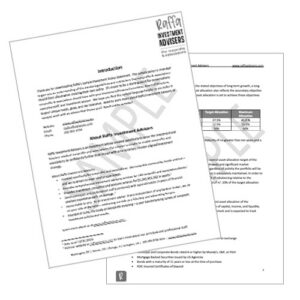
Download our Sample Investment Policy Statement
Looking to create or update your investment policy statement? This sample IPS template was created for nonprofits and associations to use as a starting point with language your board can customize to your organization’s objectives and adviser insight to assist your team throughout the process.
Our IPS Review Process
We start each client relationship with a comprehensive financial assessment and a review of both your current Investment Policy Statement and Reserve Policy to confirm alignment with your organization’s objectives, risk tolerance, and governance needs. Our goal is to understand your organization so we can make informed recommendations to strengthen your policies and overall governance.
Throughout our review process, our team maintains detailed documentation so that both current and future stakeholders are aware of how policy decisions were made.
Our Multi-Step Investment Policy Statement Development Process Includes:
Step 1: Financial Document Review
Every Nonprofit Investment Policy Statement should be grounded in a clear understanding of your organization’s financial position. We review your financial documents, including financial statements, existing policies, budgets, strategic plans, and cash flows, to understand your current financial situation, cash flow needs, and how your portfolio is operated today. This review helps us understand how your reserves are currently structured, where liquidity needs exist, and how your financial resources align with your organization’s short-term and long-term priorities.
Step 2: Information Gathering Interviews
We conduct interviews with key personnel, including your CFO, CEO, and applicable board or investment committee members. These conversations help us gain a deeper understanding of your organization’s objectives, the timing and predictability of cash flows, spending requirements, and overall risk tolerance. For organizations with multiple reserve pools, these interviews also help clarify how operating, intermediate, and long-term reserves should be segmented and managed within the Investment Policy Statement.
Step 3: Comprehensive Financial Assessment
Our comprehensive financial assessment helps bring together what we learned. Through this assessment, we assess your organization’s overall financial position, including liquidity and cash flow needs, the size and purpose of your reserves, and your capacity to take on investment risk. This forms the basis for the recommendations that follow.
Step 4: Reserve Strategy & Structure
Investment policy development is typically preceded by a broader reserve strategy and structure assessment. Once reserve objectives are defined, investment policies provide the governance framework necessary to implement those objectives consistently over time.
Many organizations hold multiple pools of assets with different purposes and time horizons, from operating cash to longer-term reserves. We help you define a reserve strategy that aligns each pool with its intended use, liquidity needs, and risk tolerance. Defining these reserve objectives allows your investment policy to serve as the governance framework that implements them consistently over time.
Step 5: Risk Tolerance Survey
We facilitate a high-level risk tolerance survey to be completed by the relevant committee or full Board. This survey is designed to gauge your fiduciaries’ willingness to endure market losses and helps identify where perspectives may differ among stakeholders. The results provide an important data point for aligning your IPS with both the organization’s financial ability to take risk and the committee’s comfort level with portfolio volatility.
Step 6: Recommended Investment Policy Changes
Once we understand your financial situation, objectives, and risk tolerance, we develop a set of recommendations, including but not limited to:
- Investment objectives and time horizons
- Asset allocation targets and ranges
- Quality and diversification standards
- Risk parameters
- Rebalancing guidelines
- Liquidity and spending guidelines
- Benchmarks
- Defined roles and responsibilities
We document these in a memo outlining each suggested change with the reasoning and supporting data, so your committee can evaluate every recommendation with full context. This documentation also helps inform future stakeholders of the basis for policy decisions.
Step 7: Updating Investment Policy Statement
We work directly with your board and committee to revise your current Investment Policy Statement or draft a new IPS from scratch. The goal is a detailed document that is tailored to your organization’s goals, risk tolerance, and governance structure. A well-crafted IPS should be easy for current and future fiduciaries to understand, implement, and oversee, providing consistency and continuity as board and committee membership changes over time.
Ongoing Monitoring & Review
We view the IPS as a living document and recommend reviewing and refining it regularly and as your objectives, cash flow needs, leadership, or market conditions evolve. Throughout, we maintain detailed documentation so current and future stakeholders understand how each policy decision was made.
Education & Insights Related to Investment Policy Development







FAQs Related to Investment Policy Statements
How often should we review or update our Investment Policy Statement?
At minimum, annually. A review does not mean a rewrite every year, though. Often the IPS is reaffirmed without changes after confirming it still reflects your organization’s goals, risk tolerance, and financial position. A more substantive review is warranted when there is significant board or committee turnover, a material change in your financial condition, a shift in your organization’s strategic direction, or a major market event that changes the investment landscape. The risk of reviewing too infrequently is that your board ends up governing against a policy that no longer matches reality. With this in mind, we recommend keeping an annual IPS review on your committee’s agenda.
Should our spending policy be part of our Investment Policy Statement?
There is no single standard. Some organizations include their spending policy directly within the IPS, while others maintain it as a separate document. What matters is that the two are aligned, because your spending rate directly impacts how your portfolio should be invested. A spending policy that is too aggressive relative to your investment strategy can erode reserves over time, while one that is too conservative may leave your organization underutilizing resources that could further its mission.
We work with your team to define when and how invested funds will be used for operational support, grantmaking, or other organizational needs, and to make sure those assumptions are reflected in your Investment Policy Statement and portfolio construction.
How much should our nonprofit hold in reserve, and how should those reserves be structured?
The answer depends on your organization’s operating budget, revenue predictability, strategic plans, and appetite for risk. We typically work with organizations to segment reserves into operating, intermediate, and long-term pools. Each segment focusing on a different time horizon, liquidity requirement, and investment approach. Operating reserves are generally designed to cover one to six months of budgeted expenses and are held in cash or cash equivalents for immediate access. Intermediate reserves support needs expected within one to five years and are typically invested more conservatively, balancing modest growth with capital preservation. Long-term reserves, intended for use beyond five years, can be invested with a greater emphasis on growth through broader diversification across asset classes. Because each pool serves a different purpose and operates on a different timeline, the investment strategy for each should reflect that.
Our process includes identifying the financial risks and opportunities your organization faces, estimating the likelihood of each, and determining how much should be set aside to address them. From there, we help you document those decisions in a reserve policy that explains not just the numbers but the reasoning behind them, so future boards and staff understand the “why” and not just the “what.”
How do you help a board with diverse perspectives on risk reach agreement on an IPS?
This is one of the most common challenges we see. Our process is designed to surface differences early through stakeholder interviews and a risk tolerance survey, then use the financial data and documented reasoning to build consensus. By grounding the conversation in your organization’s actual financial position rather than individual opinions, we help boards and committees move toward agreement on a policy that reflects the full group’s input.
Our current IPS was written years ago by a board that has since turned over. Where do we start?
An outdated IPS is better than no IPS, but it can create real problems if your board is making decisions based on assumptions that no longer reflect your organization’s financial position, risk tolerance, or goals. The first step is understanding what still holds and what doesn’t. In many cases, the core structure is sound but the assumptions behind it need to be revisited.
We walk through the same five-step review process we use with every client, which gives your current board and committee the context they need to either reaffirm, revise, or replace the existing IPS with full understanding of why it was written the way it was and what, if anything, needs to change.
Raffa created a sample IPS for nonprofits and associations looking to update or strengthen their policy. Learn more and download our sample IPS template.
Do nonprofits need an Investment Policy Statement?
There is no universal legal requirement for nonprofits to maintain an Investment Policy Statement, but having one is considered a best practice and is closely associated with sound fiduciary governance. The Uniform Prudent Management of Institutional Funds Act (UPMIFA), which governs endowment management in most states, requires that nonprofits manage investments with prudence and in alignment with organizational goals. An IPS helps provide a governance framework to fulfill this requirement. Foundations and grant-making organizations may also require grantees to demonstrate sound investment governance, making an IPS highly beneficial for organizations that rely on institutional funding.
How should an Investment Policy Statement be monitored and maintained after it is adopted?
A strong Nonprofit Investment Policy Statement should evolve alongside your organization. At minimum, it should be reviewed annually and revisited more thoroughly when there are changes in leadership, financial condition, or strategic direction. Between reviews, the IPS serves as the standard against which your portfolio is measured, with performance evaluated relative to the benchmarks and allocation targets defined in the policy.
At Raffa, we provide ongoing compliance reporting so your committee can verify that investments remain aligned with policy guidelines. We monitor performance relative to benchmarks, recommend policy updates when your organization’s circumstances change, and provide board and committee education to support informed oversight throughout the year.
Looking to update or develop your Investment Policy Statement?
Disclosures:
This material is provided for informational and educational purposes only and is intended to support general understanding of nonprofit and association investment policy considerations. It is not intended as, and should not be relied upon as, investment, legal, or tax advice, or as a recommendation or solicitation to buy, sell, or hold any security or to adopt any specific investment strategy or policy framework.
The information presented is general in nature and does not take into account the specific objectives, financial circumstances, liquidity needs, or risk tolerance of any particular organization. Each nonprofit or association should evaluate its own situation, governing policies, and operational requirements when developing or modifying an Investment Policy Statement.
All investments involve risk, including the possible loss of principal. There can be no assurance that any investment policy, strategy, asset allocation, or reserve structure will achieve its intended objectives, support decision‑making outcomes, or result in any specific level of performance or risk management.
Any references to governance processes, investment frameworks, reserve structures, or policy components are provided as general examples or considerations and may vary based on organizational needs and circumstances. Ranges, illustrations, or examples (including references to reserve levels, liquidity time horizons, or spending considerations) are not intended to represent recommended standards and may not be appropriate for all organizations.
Descriptions of processes, including financial reviews, stakeholder interviews, risk tolerance assessments, or policy development steps, are intended to illustrate general methodologies and do not guarantee any particular outcome, level of consensus, or effectiveness in decision‑making or governance.
References to monitoring, reporting, or alignment with an Investment Policy Statement are intended to support oversight and evaluation and do not ensure that investments will remain compliant with policy guidelines or that objectives will be achieved.
Raffa Wealth Management, LLC, doing business as Raffa Investment Advisers, is an SEC‑registered investment adviser. Registration does not imply a certain level of skill or training. Advisory services are provided only pursuant to a written agreement. Additional information about the firm, including its services, fees, and conflicts of interest, is available in its Form ADV Part 2, which can be obtained upon request or by visiting View SEC Adviser Information.