
Investment Management for Nonprofits and Associations
Nonprofit and association reserves require investment management that is built around policy alignment, reserve segmentation, and fiduciary oversight.
How We Manage Nonprofit and Association Investment Portfolios

We serve as a fiduciary investment adviser for nonprofit organizations and associations, managing reserves, endowments, and long-term investment portfolios. For most clients, this means serving in an Outsourced Chief Investment Officer (OCIO) capacity, taking on responsibility for portfolio management decisions within the parameters defined by your Investment Policy Statement (IPS). Our investment approach emphasizes diversification, cost discipline, and alignment with your IPS, with reporting structured to support board and committee oversight.
What Nonprofit Investment Management Includes
Nonprofit and association investment management goes beyond selecting investments. It covers the full cycle of building, monitoring, maintaining, and reporting on an investment portfolio that is aligned with your Investment Policy Statement, reserve structure, and spending needs. When these elements are connected, your board and committee can oversee the investment program with the context they need to evaluate whether it is performing in line with the investment policy.
Asset Allocation
Investment Selection
Rebalancing
Risk Management
Cash & Liquidity Management
Reporting & Compliance
Ongoing Communication
ESG & Values-Based Investing
Reporting and Oversight for Nonprofit Investment Portfolios
Investment reporting for nonprofits and associations should tie portfolio results back to the objectives and guidelines outlined in your Investment Policy Statement. Reports structured around your IPS give your committee the context to ask informed questions and focus on what matters during meetings.
Our Clients Receive:
A Monthly Dashboard Report
Raffa clients receive a monthly dashboard report that provides visibility between committee meetings. The dashboard includes portfolio balances, recent activity, performance context relative to benchmarks, and confirmation that investments remain aligned with IPS guidelines. It is distributed to designated stakeholders and is designed to keep your team informed.
A Quarterly Report to Assist with Board Meetings
Our quarterly performance report is designed for Board or Investment Committee meetings. It reviews performance versus policy benchmarks, asset allocation relative to targets and ranges, and relevant risk and liquidity considerations. Commentary is written to support committee-level discussion and is structured around the questions your fiduciaries are responsible for answering: are we in compliance with our policy, and is performance tracking as expected?
Access to an Online Client Portal
Designated representatives have secure, web-based access to portfolio information through a portal that updates daily. Authorized users can view balances, performance, holdings, transactions, and key documents including reports and the IPS. The portal is available 24/7 and is customizable based on your organization’s preferences.
Timely Market & Economic Updates
Advisers provide monthly market commentary and timely updates as economic developments arise. When market movements or economic events may affect your organization’s investment program, we share context through written updates so your staff and committee stay informed between meetings.
Raffa Insights & Resources
Created for the Nonprofit and Association Community

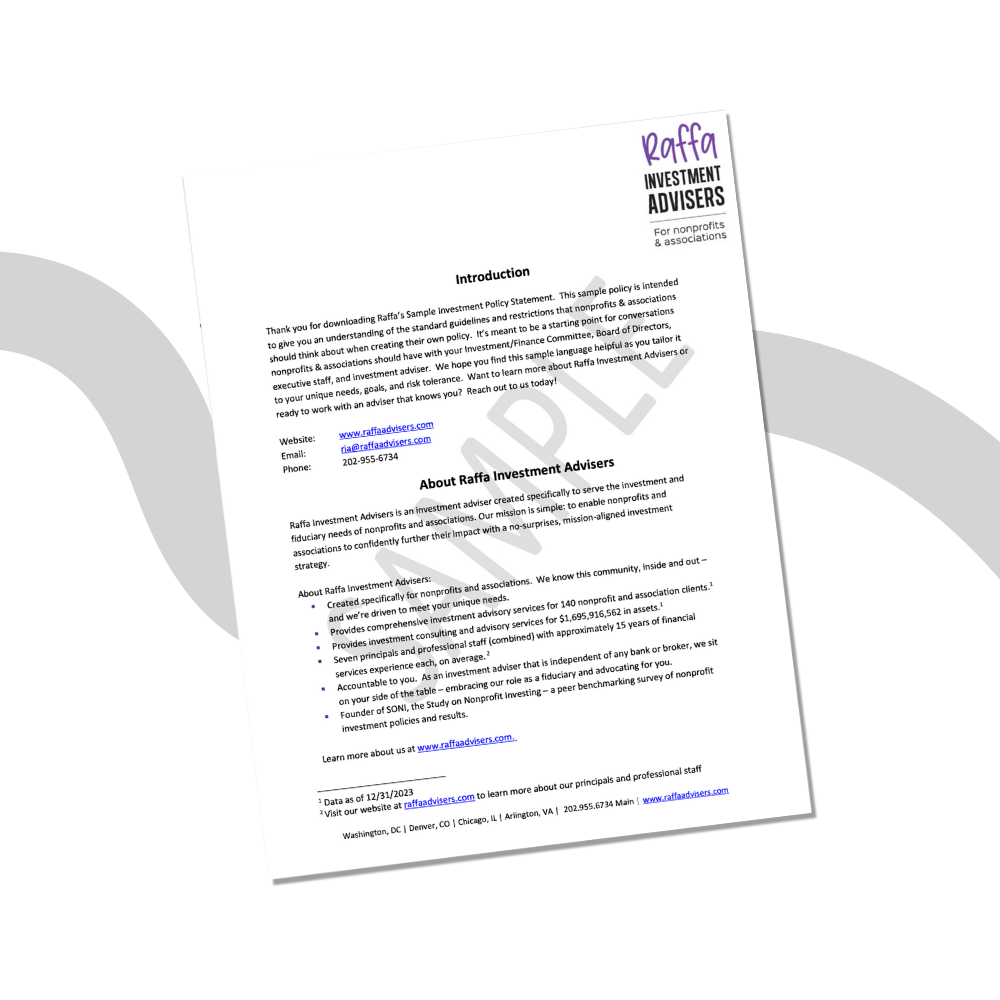

Frequently Asked Questions Related to Nonprofit Investment Management
What does an Outsourced Chief Investment Officer (OCIO) do for a nonprofit?
An OCIO takes on the day-to-day responsibility of managing your organization’s investment portfolio within the guidelines defined by your Investment Policy Statement. This includes asset allocation, investment selection, rebalancing, risk management, reporting, and communication with your board and committee. The board retains oversight and policy authority while the OCIO handles execution.
Learn more about OCIOs and the difference between discretionary investment management and non-discretionary investment management for nonprofits.
How should a nonprofit structure its investment portfolio across different reserve pools?
Many nonprofits choose to segment reserves by time horizon and purpose. Operating reserves covering near-term expenses are typically held in cash or cash equivalents. Intermediate reserves supporting needs within one to five years are invested more conservatively. Long-term reserves intended for use beyond five years can be allocated with a greater emphasis on growth. Each pool should have its own allocation targets and risk parameters documented in your Investment Policy Statement.
What is the difference between discretionary and non-discretionary investment management for nonprofits?
In a discretionary investment management arrangement, your investment adviser manages portfolio decisions within the parameters defined by your Investment Policy Statement without requiring board approval for each trade. In a non-discretionary arrangement, the adviser makes recommendations and the board or committee approves each decision before execution. Most nonprofit and association clients engage on a discretionary basis because it allows for timely implementation, but both structures are common.
What should nonprofits look for in investment reporting?
Investment reporting should connect portfolio results to the objectives and guidelines outlined in your Investment Policy Statement. That means showing performance relative to benchmarks, asset allocation relative to targets, and compliance with policy guidelines. Reports that only show returns without that policy context make it difficult for your committee to evaluate whether the investment program is performing as intended.
How does a nonprofit balance the need for liquidity with long-term investment growth?
This is one of the central challenges in nonprofit portfolio management. The answer depends on your organization’s spending needs, revenue predictability, and reserve structure. Segmenting reserves by time horizon allows you to maintain liquidity for near-term needs while investing longer-term funds for growth. Your Investment Policy Statement should define the liquidity requirements for each reserve pool and the allocation approach that supports them.
How often should a nonprofit's investment portfolio be rebalanced?
Rebalancing should happen when allocations drift outside the ranges defined in your Investment Policy Statement or when cash flows create an opportunity to restore alignment. This is an ongoing process, not a calendar-driven event. Disciplined rebalancing helps maintain the risk profile your board approved and avoids letting market movements push the portfolio away from its intended structure.
What role does the board play in overseeing a nonprofit's investment portfolio?
The board or investment committee is responsible for setting the Investment Policy Statement, approving the investment strategy, and overseeing whether the portfolio is being managed in alignment with policy. Day-to-day portfolio decisions are typically delegated to the investment adviser. Regular reporting, committee meetings, and ongoing education help board members fulfill their fiduciary oversight responsibilities.
Looking For an OCIO to Assist with Your Nonprofit's Investment Portfolio?
Disclosures:
This material is provided for informational and educational purposes only and is intended to support general understanding of nonprofit and association investment management considerations. It is not intended as, and should not be relied upon as, investment, legal, or tax advice or as a recommendation or solicitation to buy, sell, or hold any security or to adopt any specific investment strategy.
The information presented is general in nature and does not take into account the specific objectives, financial circumstances, liquidity needs, or risk tolerance of any particular organization. Each nonprofit or association should evaluate its own situation and governing policies when making investment decisions. All investments involve risk, including the possible loss of principal. There can be no assurance that any investment strategy, asset allocation, or portfolio structure will achieve its objectives, generate returns, or avoid losses. References to diversification, rebalancing, asset allocation, or risk management are intended to describe general investment concepts and approaches and do not guarantee any specific outcome or level of risk reduction.
Any references to investment performance, monitoring, or evaluation relative to benchmarks or policy objectives are provided for illustrative purposes only and do not imply that results will be consistent with expectations or that objectives will be achieved. Market conditions, interest rates, economic developments, and other factors may affect performance and outcomes.
Discussion of environmental, social, and governance (ESG) or values based investing considerations may involve subjective judgments and differing methodologies. ESG strategies may limit investment opportunities and may perform differently than strategies that do not incorporate such considerations. There is no guarantee that ESG or values-based approaches will achieve their intended results or align with the preferences of all stakeholders.
References to discretionary investment management or Outsourced Chief Investment Officer (OCIO) services are intended to describe general service models. The scope of authority, responsibilities, and decision making processes are defined in a written agreement and the client’s Investment Policy Statement. The client’s board or investment committee retains ultimate fiduciary oversight and policy authority.
Any descriptions of services, processes, reporting, tools, or communication practices are provided for illustrative purposes only and are not intended to represent a guarantee of performance, outcomes, or client experience. Availability and features may vary.
Raffa Wealth Management, LLC, doing business as Raffa Investment Advisers, is an SEC registered investment adviser. Registration does not imply a certain level of skill or training. Advisory services are provided only pursuant to a written agreement. Additional information about the firm, including its services, fees, and conflicts of interest, is available in its Form ADV Part 2, which can be obtained upon request or by visiting https://www.adviserinfo.sec.gov.