

This article focuses on the market and economic implications of the conflict in Iran. For guidance on how these dynamics affect your organization’s financial strategy, read our tailored recommendations for charitable nonprofits and foundations or for associations and membership-based organizations.
Understanding the Iran Conflict in HIstOrical Context
Recent developments involving Iran have understandably raised questions about how geopolitical events may affect markets and portfolios. Military conflicts and political tensions can create uncertainty for investors and often lead to periods of market volatility. These recent developments have once again raised questions about how global events may influence financial markets and investment portfolios.
The following reviews the current situation in Iran, examines how markets have historically responded to geopolitical conflicts, considers whether current conditions present unique risks, and discusses how diversified portfolios are positioned to navigate these developments.
The War in Iran and Its IMpact on Markets
At the end of February, the U.S. and Israel launched airstrikes on Iran. Iran has fought back in kind by attacking U.S. bases, other Middle East nations, and effectively closing the Strait of Hormuz, a major oil shipping lane, by threatening to attack ships that pass through. The fighting is ongoing and it’s unclear when it might end. As with many geopolitical developments, investors initially assess the potential implications for oil supply, inflation, and global economic growth and how that will impact stock and bond prices.
Energy markets often respond quickly to events in the region because the Middle East accounts for roughly 30% of the global oil supply[1], and 20% passes through the Strait of Hormuz[2]. With the shipping lane essentially closed and significant uncertainty over how long the conflict will last, there have been significant swings in oil prices. Prices have risen roughly $30 per barrel since the conflict began, hovering around $100 per barrel as of the time of this article (3/19/26).
The sharp increase in oil prices has raised concerns about global economic growth, corporate earnings, and inflation. Since the conflict began, U.S. and International equities have declined. U.S. stocks have held up somewhat better in part because the U.S. is a net exporter of energy and therefore somewhat more insulated from disruptions in global oil markets. Rising inflation concerns have also weighed on bonds.
[1] Source: https://insight.spglobal.com/story/platts-oil-security-sentinel/page/2
Historical Conflicts and Market Behavior
Historical context provides useful perspective when evaluating geopolitical developments. Over the past century, global markets have navigated numerous conflicts, including wars, terrorist attacks, and regional military actions. While these events often increase uncertainty in the near term, their long-term impact on financial markets has generally been limited.
Figure 1 shows U.S. stock market performance following several major geopolitical events since World War II. While returns in the months immediately following conflicts have varied widely, longer-term outcomes have frequently remained positive as markets factor in new information and set stock prices for positive expected returns. In many cases, markets began recovering well before geopolitical tensions were fully resolved.
Figure 1: U.S. Stock Performance After Conflicts

Disclosures: Data from July 1926 – December 2025. Returns greater than one year are annualized. Past performance is no guarantee of future results.
Source: Ken French Data Library
A longer-term perspective reinforces this pattern. Figure 2 illustrates the growth of $1 invested in U.S. stocks since 1926, with major geopolitical conflicts marked along the timeline. Despite numerous wars and global crises over the past century, the long-term trajectory of the market has remained upward.
Figure 2: Growth of $1 in U.S. Stocks Since 1926
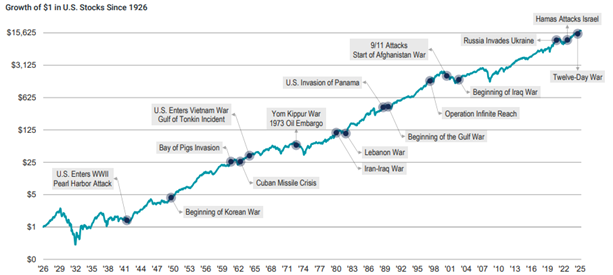
Disclosures: Data from July 1926 – December 2025. Returns greater than one year are annualized. Past performance is no guarantee of future results.
Source: Ken French Data Library
While geopolitical conflicts can create periods of uncertainty, markets have repeatedly demonstrated resilience over time.
Is This Time Different?
It is natural for investors to ask whether the current geopolitical environment presents unique risks. Today’s economic landscape includes several ongoing challenges, including elevated inflation in many economies, higher interest rates, and geopolitical tensions across multiple regions. While current conditions present real uncertainties, the underlying dynamics are not unprecedented.
Conflicts involving major energy-producing regions can influence inflation expectations and global supply chains, which can contribute to short-term market volatility. However, the global economy remains highly diversified and adaptable, and financial markets typically incorporate new information quickly as conditions evolve.
Geopolitical developments typically affect specific regions or industries rather than the entire global economy. As a result, their long-term impact on diversified investment portfolios has historically been limited relative to broader economic forces such as productivity growth, corporate profitability, and monetary policy.
The impact this war has on markets will be driven by its duration, the longer the war, the greater the impact. A quick resolution could see markets rebound quickly, while a more prolonged conflict could weigh more heavily on growth and inflation and in turn stock and bond markets. While it is unclear how long the hostilities will last, we remain confident in the long-term resilience of global stock markets.
Portfolio POsitioning During Geopolitical Uncertainty
Periods of geopolitical uncertainty reinforce the importance of maintaining diversified portfolios and a disciplined long-term investment approach.
Rather than attempting to predict short-term market movements or react to geopolitical headlines, our focus remains on maintaining appropriate exposure across asset classes and global markets.
This approach reflects several core principles. Asset allocation is the primary driver of long-term portfolio outcomes. Certain equity characteristics such as a company’s relative size, lower priced/higher dividend-paying stocks, and relatively more profitable companies, have historically been associated with higher expected returns. Fixed income provides stability and income within portfolios, while broad, cost-efficient diversification supports more resilient investment outcomes over time.
Balanced portfolios combine exposure to global equities and high-quality fixed income investments. Equities provide participation in long-term economic growth, while bonds can help moderate volatility and provide income during periods of market stress.
If the conflict drives U.S. or international stock markets down further, creating meaningful deviations from investment targets, we will seek to take advantage of the market volatility by selling from investments performing relatively well and buying into assets at lower prices.
Market history also highlights the behavioral challenges investors face during periods of geopolitical uncertainty. Events such as military conflicts can provoke strong emotional reactions and tempt investors to make abrupt changes to their portfolios. However, maintaining discipline and remaining focused on long-term financial objectives has historically rewarded investors.
Conclusion
The current tensions involving Iran have understandably raised questions about potential impacts on energy markets, inflation, and global economic stability. Importantly, these developments do not change our long-term investment approach or portfolio positioning.
While geopolitical conflicts can introduce uncertainty and short-term volatility, history shows that financial markets have repeatedly adapted to such events over time. For long-term investors, maintaining diversified portfolios and a disciplined investment strategy remains one of the most effective ways to navigate periods of geopolitical uncertainty while continuing to pursue long-term financial goals.
Disclosures:
For informational purposes only. Investments involve risks. All economic and performance information is historical and not indicative of future results. Different types of investments involve varying degrees of risk, and there can be no assurance that the future performance of any specific investment, investment strategy, or product made reference to directly or indirectly in this material, will be profitable, equal any corresponding indicated historical performance level(s), or be suitable for your portfolio. There is no guarantee investment strategies will be successful. The charts and graphs contained herein should not serve as the sole determining factor for making investment decisions. You should not assume that any discussion or information provided here serves as the receipt of, or as a substitute for, personalized investment advice from Raffa Investment Advisers or any other investment professional. Information and opinions presented in this material have been obtained or derived from sources believed by Raffa to be reliable as of the date of this article, but we do not guarantee its accuracy.
Raffa actively leverages Artificial Intelligence (“AI”) and Large Language Models (“LLMs”) within our operations. The use of such technologies, focusing on the safeguard of non-public personal information (“NPPI”), protecting of trade secrets, verification of information accuracy, and other pertinent compliance considerations, is outlined in Raffa’s Compliance Manual and acknowledged by Raffa staff. All viewpoints and final content created was reviewed and approved by the Raffa team to verify accuracy, perspective, and compliance with our marketing guidelines.
Information pertaining to Raffa Investment Advisers’ advisory operations, services, and fees is set forth in Raffa Investment Advisers current disclosure statement, a copy of which is available from Raffa Investment Advisors upon request.