
Nonprofit Finance Committee and Board Support
Investment oversight at a nonprofit or association involves year-round fiduciary work, not just a quarterly performance review. The decisions a finance committee or board make can shape the investment program for years.
Fiduciary Pressures Nonprofit Finance Committees and Boards Face

For nonprofit and association finance committees and boards, the pressure of fiduciary oversight is steady. Members are responsible for setting policy, evaluating reserves, reviewing performance against benchmarks, confirming compliance, and reporting to the broader board. This work is often done by volunteers with personal time constraints, rotating terms, and limited investment background. Additionally, as investment needs evolve with the organization’s growth, it can be challenging to evaluate how past decisions align with current organizational goals.
We help finance committees and boards address these pressures using processes refined over Raffa’s 20+ years of working with nonprofit and association clients. Our experience with similar organizations shapes how we approach committee meetings, work alongside staff, and onboard new members as terms turn over. We also continually develop resources and educational content for our clients and the broader nonprofit and association industry. Together, our goal is to simplify governance while supporting continuity for finance committees and boards through changing membership and evolving organizational needs.
How We Support Nonprofit Finance Committees, Boards, and Staff
Effective support for nonprofit and association finance committees and boards depends on consistent attention to the responsibilities they carry, familiarity with how committees function, and resources that adapt as organizations evolve. A few ways in which we support nonprofit and association finance committees, boards, and staff include:
Investment Reporting & Dashboards
Board Education & Training
Donor Engagement Support
Peer Benchmarking
Common Challenges Nonprofit Finance Committees and Boards Face
Finance committees and boards at nonprofits and associations face a steady mix of operational, policy, and strategic challenges, often with limited time and rotating membership. The topics below cover a few of the common challenges we see our clients face:
Understanding Fiduciary Responsibilities for Investment Oversight
Nonprofit and association finance committee and board members carry significant fiduciary responsibility to the organization. New members may be unsure what duty of care, duty of loyalty, and adherence to the organization’s mission mean in practice for investment oversight. Even experienced members may not always have a clear framework for what specific decisions count as fiduciary judgment versus delegated execution.
Raffa includes fiduciary education for finance committees and boards as part of the advisory relationship. Sessions cover what fiduciary duty means for investment oversight, how an Investment Policy Statement provides a framework for fulfilling those duties, and the questions members should be prepared to answer during board reviews. Education is tailored to the experience level of the group and can fit inside a regular committee meeting or stand on its own.
Determining the Right Reserve Level and Spending Policy
How much a nonprofit or association should hold in reserves, and how those reserves should be drawn down through a spending policy, are two of the most frequently asked questions in nonprofit finance. The right answer depends on revenue predictability, cost structure, strategic plans, and the role each pool of reserves plays for the organization. Without a documented framework, those decisions tend to default to general rules of thumb that may not fit the organization’s actual circumstances.
Raffa works with finance committees and boards to advise on both a reserve strategy and a spending policy, often documented in coordination with the Investment Policy Statement. The process segments reserves by purpose and time horizon, evaluates how much should be held in each pool, and clarifies how and when invested funds may be drawn down for operational support or other organizational needs. The result is a framework current and future committees can govern against.
Additionally, Raffa helps provide an additional layer of context through our peer benchmarking tool. This tool allows your organization to compare your reserves and financial metrics against more than 380,000 nonprofit organizations using publicly available IRS Form 990 data. Data segmentation is available to create comparisons against more tailored peer groups.
Aligning Investment Policy with Organizational Goals
An Investment Policy Statement that was written years ago by a different board may no longer reflect the organization’s current goals, risk tolerance, or financial position. Without periodic review, the IPS can drift from what the committee actually believes about the program, and decisions made today may rest on assumptions that no longer apply.
Raffa works with finance committees and boards to develop, review, and refresh the Investment Policy Statement so it reflects how the organization operates today. The process draws on financial document review, stakeholder interviews, a risk tolerance survey, and a documented memo of recommended changes. The result is a policy current and future fiduciaries can govern against.
Evaluating Performance, Investment Strategy, and Risk
Investment performance for a nonprofit or association is typically evaluated against the benchmarks defined in the Investment Policy Statement, not just absolute returns or broad market indexes. Without consistent benchmarks tied to your allocation, and without peer context for the bigger questions like reserve adequacy and allocation appropriateness, performance reviews can become anecdotal or focused on short-term swings. Market volatility, economic shifts, and unexpected events add another layer that is not always clear from a quarterly portfolio summary alone.
Raffa structures investment reporting around your IPS so the committee can evaluate performance against the benchmarks the policy establishes. Monthly dashboards and quarterly performance reports cover allocation, policy compliance, and performance over multiple time periods. The SONI Dashboard adds peer context by comparing your reserves, allocation, and operating metrics against more than 380,000 nonprofit organizations using publicly available IRS Form 990 data. Ongoing market and economic commentary, plus timely updates when significant events affect the portfolio or broader environment, give the committee the context to evaluate strategy, performance, and risk together. A single quarter of underperformance does not necessarily indicate a problem, just as a single quarter of outperformance does not necessarily indicate success.
Maintaining Continuity as Committee and Board Members Rotate
Volunteer turnover is a constant in nonprofit and association governance. Members rotate off the finance committee, investment committee, or board on a regular cycle. With this, each new member inherits an Investment Policy Statement, prior reserve decisions, and a portfolio already in motion. Without a structured way to bring them up to speed, institutional knowledge fades.
Raffa builds continuity into the advisory relationship. Our advisers are available to walk new members through the IPS, current dashboard, prior decisions, and the reasoning behind your reserve and allocation structure. Additionally, educational sessions are offered to fill in any knowledge gaps whether one-on-one or for the full committee or board.
Donor Education on Tax-Efficient Charitable Giving
Charitable giving conversations often involve questions that a development team or finance committee may not have the answers to. Donors ask about tax-efficient giving, donor-advised funds, planned gifts, and how each option might fit their situation.
Raffa advisers are able to meet with donors one-on-one, host educational events to answer common questions related to charitable giving, and assist with your fundraising team on messaging that would benefit from investment adviser-level context. Through Charles Schwab Institutional and DAFGiving360, we also have access to philanthropic platforms and reference material on charitable giving strategies.
Raffa INSIGHTS & RESOURCES
Created for the Nonprofit & Association Community

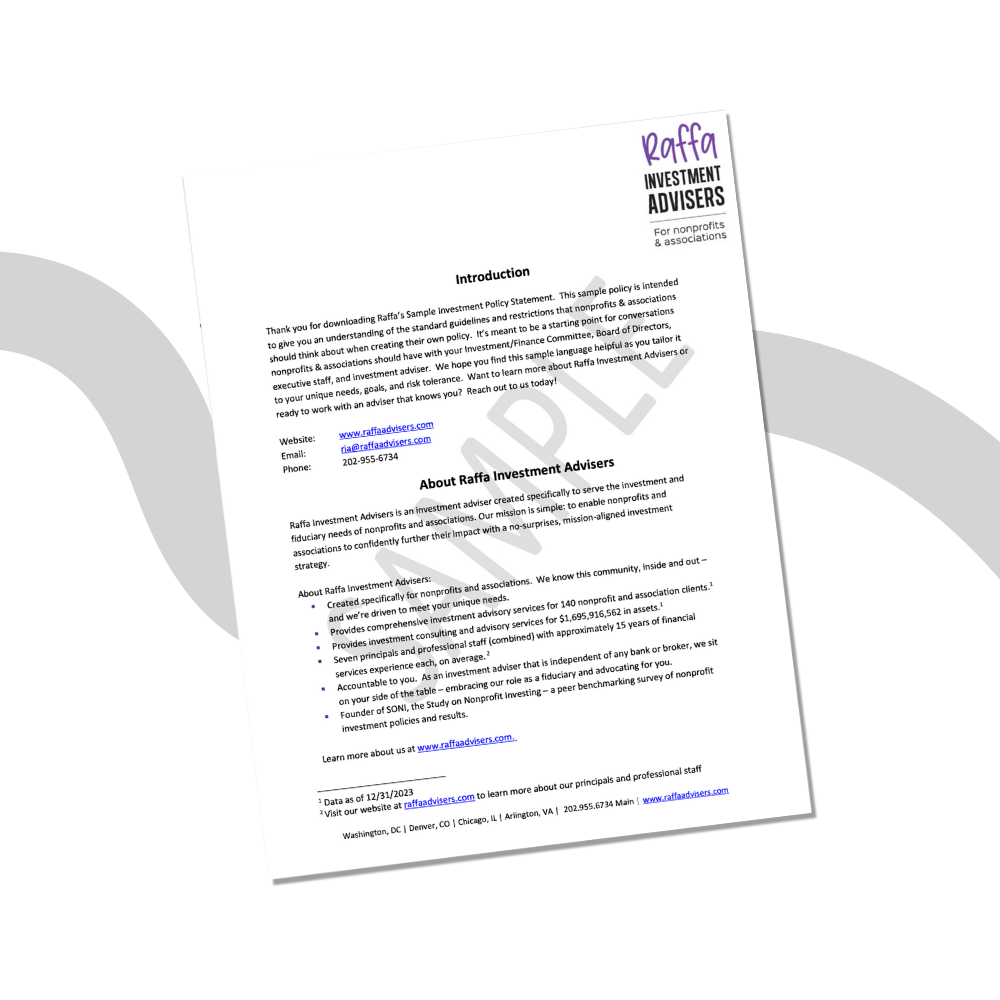

Frequently Asked Questions About Nonprofit Finance Committee and Board Support
What is a nonprofit finance committee responsible for?
A nonprofit finance committee is responsible for overseeing the financial health of the organization, which typically includes reviewing budgets, financial reporting, internal controls, reserves, and the investment program. Members are often responsible for reviewing periodic financial statements, supporting the annual budget process, overseeing the annual audit, managing the investment program, and working alongside the CFO and executive director on financial policy and risk.
When it comes to overseeing the investment program, members are responsible for overseeing the implementation of the investment strategy inline with the Investment Policy Statement. This includes reviewing performance against defined benchmarks and confirming allocation and risk parameters remain appropriate as the organization’s circumstances evolve. Raffa partners with our clients in support of this fiduciary oversight through our IPS development, reserve strategy assistance, reporting dashboards, peer benchmarking, and board education.
What's the difference between a finance committee and an investment committee at a nonprofit?
A finance committee at a nonprofit or association generally oversees the full financial picture: budget, reporting, internal controls, reserves, and often the investment program. An investment committee is a more specialized body that focuses on the investment portfolio, the Investment Policy Statement, and adviser oversight. Smaller organizations often have a single finance committee that handles both. Larger organizations, or those with significant invested reserves, frequently establish a separate investment committee that reports up through the finance committee or directly to the board. Both structures can be effective; what matters is that roles and responsibilities are clearly assigned.
How does peer benchmarking help nonprofit finance committee and board decisions?
Peer benchmarking gives nonprofit finance committees and boards a reference point for evaluating reserves, asset allocation, and operating metrics against similar organizations. This is useful when the committee is reviewing reserve strategy, considering a change to the investment policy, or fielding board questions about whether financial decisions are in line with comparable nonprofits. The SONI Dashboard, developed by Raffa, draws on IRS Form 990 data from more than 380,000 nonprofit organizations and can be filtered by 501(c) type, operating budget, focus area, employees, and location. There is no universally correct reserve level, but a defensible peer comparison often adds context that can improve the quality of the conversation.
How can a nonprofit work with an investment adviser on donor education and charitable giving conversations?
Nonprofit and association teams often struggle when donor conversations turn to questions about tax-efficient charitable giving, donor-advised funds, planned gifts, or how those options work in practice. An investment adviser can support the fundraising team and finance committee by meeting one-on-one with donors and hosting educational events for donors on charitable giving strategies. This support is not intended to manage donor relationships, but to share additional knowledge that may help build confidence in donor decisions. Through Charles Schwab Institutional and DAFGiving360, Raffa also has access to philanthropic platforms and reference material on charitable giving.
Looking for an Investment Adviser that Provides Support for Your Finance Committee and Board?
Disclosures:
The information provided on this page is for general informational and educational purposes only and does not constitute individualized investment, legal, tax, or accounting advice. Raffa Investment Advisers (“Raffa”) is a registered investment adviser. Registration does not imply a certain level of skill or training.
Advisory services are provided only pursuant to a written investment advisory agreement and are limited to the scope of services agreed upon with each client. References to fiduciary support, governance processes, reserve strategy, investment policy development, reporting, benchmarking, committee education, or donor‑related support reflect Raffa’s investment advisory role and do not replace the fiduciary responsibilities of a nonprofit’s finance committee or board.
Any donor education or charitable giving discussions are provided for general informational purposes and are not intended as individualized tax, legal, or estate planning advice. Donors and organizations should consult their own tax and legal advisers regarding charitable giving strategies and individual circumstances.
Peer benchmarking references, including comparisons using publicly available nonprofit data, are provided for context only and do not imply that any particular reserve level, investment strategy, or governance structure is appropriate for all organizations.
Investment strategies involve risk, including the potential loss of principal. Past experience or references to services do not guarantee future results.