
Nonprofit Qualified Retirement Plans: 401(k) and 403(b)
For nonprofits and associations sponsoring a qualified retirement plan, such as a 401(k) or 403(b), ongoing oversight is a fiduciary responsibility. We support plan sponsors with investment selection, fee benchmarking, plan design considerations in coordination with ERISA counsel, and participant education.
Managing 401(k) and 403(b) Plans for Nonprofits and Associations

A qualified retirement plan, such as a 401(k) or 403(b), is often part of the standard benefits offering at a nonprofit or association, supporting employees as they work toward their long-term financial goals. Once a plan is in place, overseeing it is a fiduciary responsibility that involves selecting and monitoring investments, evaluating provider fees, coordinating between vendors, documenting decisions, and supporting participants. While the rules and standards differ slightly between plan types, the underlying fiduciary responsibilities are largely the same.
We work alongside your leadership team, HR team, finance committee, and outside service providers on plan oversight. As an investment adviser, our role includes benchmarking plan costs, evaluating and monitoring the investment lineup, supporting fiduciary documentation, and providing participant education and one-on-one guidance.
What Nonprofit Plan Sponsor Oversight Includes
Overseeing a qualified retirement plan, such as a 401(k) or 403(b), is complex. Plan costs are spread across investment expenses, recordkeeping, and administration, with the total not always visible at a glance. Multiple service providers perform different aspects of the work, and the lines between their roles can blur over time. Selecting an investment lineup means balancing cost, fund performance, and the range of options participants need at different stages of life. Each decision needs to be documented to support fiduciary and governance responsibilities. Our team understands the complexities of plan oversight and the intricacies of working with multiple service providers. Key areas of qualified retirement plan oversight where our team can help include:
Fiduciary Oversight & Process
Investment Lineup & Structure
Fee Transparency
Benchmarking
Vendor Oversight & Coordination
Plan Design
Plan Governance
Participant Guidance & Education
How We Support Nonprofit and Association Plan Sponsors
Our work with nonprofit and association 401(k) and 403(b) plan sponsors typically focuses on a few key areas where we are able to provide value alongside your committee, leadership team, HR representative, and other outside service providers. The panels below describe what that work looks like in practice.
Establishing a Fiduciary Process
Establishing a fiduciary process includes defining how decisions are made, reviewed, and documented to create consistency. For nonprofit retirement plans such as 401(k) and 403(b) plans, this typically spans committee meetings, investment oversight, and vendor evaluations. We help your team define the cadence, criteria, and documentation that support this work, creating consistency that holds up over time, especially as committee membership rotates.
Improving Fee Transparency
Plan costs at a nonprofit or association retirement plan can be difficult to calculate because fees are often embedded within investment expenses or spread across multiple service providers. The total spans investment expenses, recordkeeping, and administration. We help clarify how fees are structured so the committee can evaluate and monitor them over time.
Simplifying Investment Structure
An investment lineup is the set of funds participants can choose from in their retirement plan. These lineups can become complex over time, particularly when multiple managers or layers of fees accumulate. We work with your nonprofit or association leadership team and finance committee to evaluate the current lineup against participant needs, and where appropriate, recommend a structure that is cost-effective, easier to understand, and aligned with how participants use the plan.
Coordinating Across Providers
Nonprofit and association retirement plans typically rely on multiple service providers, and roles and responsibilities can become unclear over time. We serve as a point of coordination, helping the committee interpret information from each provider and maintaining alignment across your recordkeeper, administrator, and other partners.
Providing Direct Participant Support
Participant education associated with a nonprofit or association retirement plan includes helping participants make informed decisions about how to save and invest. We provide both group education sessions and one-on-one conversations with our investment advisers. These conversations help participants understand their plan and make decisions that align with their retirement goals.
Raffa INSIGHTS & RESOURCES
Created for the Nonprofit & Association Community

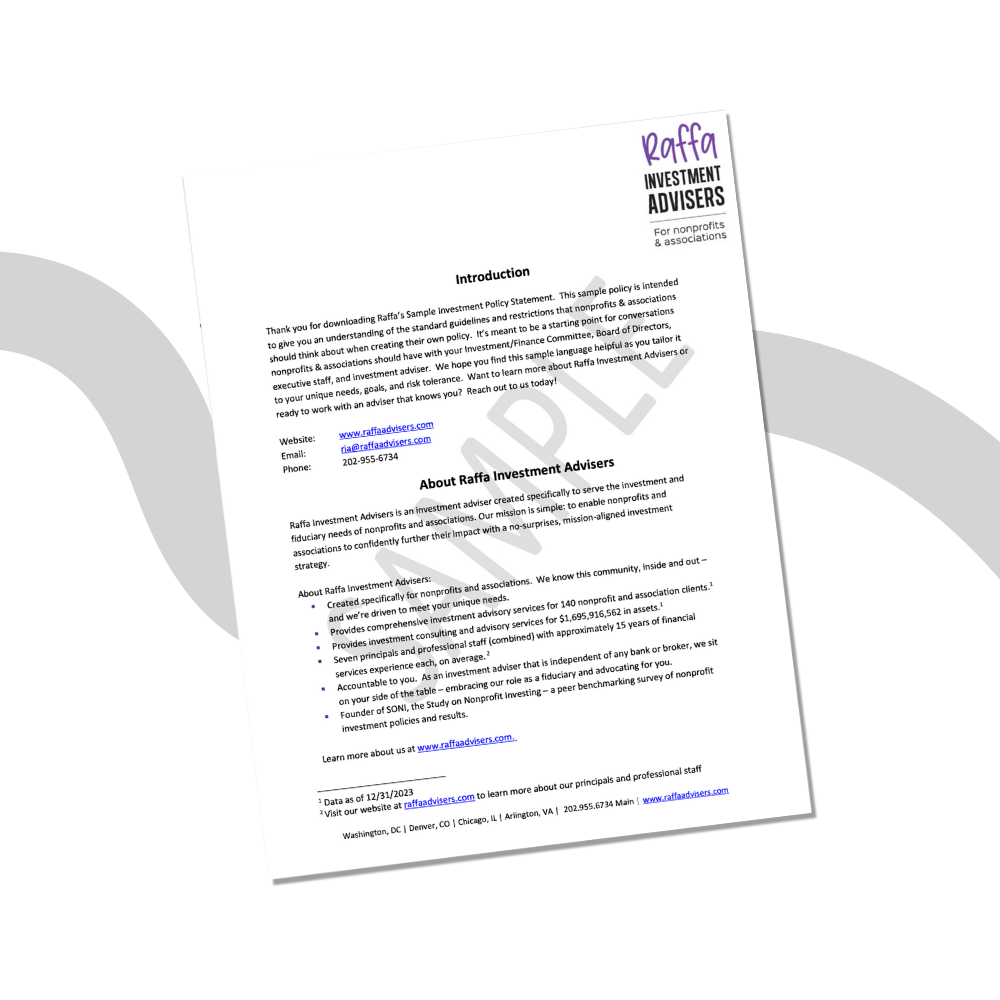

Frequently Asked Questions About Nonprofit Qualified Retirement Plans
What types of retirement plans do nonprofits typically sponsor?
Nonprofits and associations typically sponsor one or more retirement plans for their employees. Qualified plan options include 401(k) plans and 403(b) plans. Some nonprofits also offer non-qualified or deferred compensation arrangements, like 457(b) and 457(f) plans. These plans are typically in addition to a qualified plan and are designed to assist with executive or key employee retention. The right combination depends on workforce demographics, compensation philosophy, and the role retirement benefits play in attracting and retaining staff.
What is the difference between a 401(k) and a 403(b) plan for nonprofits?
401(k) and 403(b) plans share the same employee deferral limits and many of the same operational features, including employer contributions, vesting schedules, and loan provisions. 403(b) plans are specifically authorized for tax-exempt organizations and certain public sector employers, while 401(k) plans are available to most types of employers.
How is fiduciary responsibility different for ERISA and non-ERISA 403(b) plans?
ERISA-covered plans, including most 401(k) plans and many 403(b) plans, require plan sponsors to act solely in the interest of participants, follow a documented investment process, monitor fees, and report annually on Form 5500. Some 403(b) plans are exempt from ERISA, particularly those sponsored by certain nonprofits with limited employer involvement in plan administration. Plan sponsors at nonprofits and associations typically apply similar oversight standards to both, since the underlying responsibility to support participants does not change based on the regulatory framework.
What is the difference between a 3(21) and a 3(38) fiduciary?
A 3(21) fiduciary provides advice and recommendations, with the plan sponsor retaining final decision-making authority. A 3(38) fiduciary, by contrast, has discretion to make investment decisions on behalf of the plan within the framework established by the investment policy statement. The choice between the two comes down to whether the plan sponsor prefers to retain decision-making authority or delegate it. Raffa Investment Advisers is able to serve as either a 3(21) co-fiduciary or a 3(38) discretionary fiduciary at a nonprofit or association, depending on your committee’s preference. In both structures, our role is to act in the plan’s best interest by supporting investment oversight, vendor evaluation, and overall plan governance.
How are 401(k) and 403(b) plan fees evaluated to determine what is reasonable?
Fees for a nonprofit 401(k) or 403(b) plan are typically evaluated by comparing total plan costs to plans of similar size and complexity to determine what is reasonable. Total plan costs include investment expenses, recordkeeping and administrative fees, and any revenue-sharing arrangements between providers. When it comes to evaluating fees for a qualified retirement plan, the opportunity is often not just in reducing fees but improving transparency, so costs can be evaluated and monitored over time.
How are investments in a nonprofit 401(k) or 403(b) plan selected and monitored?
Investments in a nonprofit 401(k) or 403(b) plan are typically evaluated against criteria such as cost, performance, consistency, and overall fit within the lineup. When a fund no longer meets expectations, the plan sponsor should follow a structured process for replacing it, with clear documentation supporting each decision. This monitoring typically happens on a defined schedule as part of the plan’s broader fiduciary process.
Schedule a Fiduciary Review of Your Nonprofit Retirement Plan
Disclosures:
The information provided on this page is for general informational and educational purposes only and does not constitute individualized investment, legal, or tax advice. Raffa Investment Advisers (“Raffa”) is a registered investment adviser. Registration does not imply a certain level of skill or training.
Advisory services related to nonprofit and association retirement plans, including 401(k) and 403(b) plans, are provided only pursuant to a written investment advisory agreement and are subject to the scope of services agreed upon with each client. References to fiduciary support, plan design considerations, investment selection, fee benchmarking, and participant education reflect Raffa’s investment advisory role and do not include legal, tax, or ERISA plan drafting services.
Raffa may serve, by agreement, as a co fiduciary under ERISA Section 3(21) or as a discretionary fiduciary under ERISA Section 3(38), as applicable. Fiduciary status, discretion, and responsibilities are defined solely by written agreement.
Participant education and guidance services may include general investment information and, where applicable, individualized advice. Organizations and plan participants should consult their legal, tax, and other professional advisers regarding plan design, compliance, and individual circumstances.
Investment strategies involve risk, including the potential loss of principal. Past experience or references to services do not guarantee future results.