

The New IPO Wave
SpaceX’s public-market debut has brought IPOs back into the spotlight. The company listed at a valuation of roughly $1.8 trillion1, making it the largest IPO ever and making it one of the largest publicly traded companies in the world by market value. With OpenAI, Anthropic, and other high-profile private companies expected to go public later in the year at very high valuations, many investors are asking whether newly public companies represent unique opportunities or whether exposure through diversified portfolios is sufficient.
In this piece, we review how IPOs work, what history has taught us about IPOs, and how we think about IPO exposure within a disciplined long-term investment strategy.
IPO 101
An Initial Public Offering, or IPO, occurs when a private company offers shares to public investors for the first time. IPOs can allow companies to raise capital, provide liquidity to early investors and employees, and gain broader access to public markets. For investors, IPOs can be exciting because they offer the possibility of owning companies early in their public market life.
In practice, investors do not need to buy shares immediately after an IPO to gain exposure to newly public companies. For many diversified investors, IPO exposure is often introduced indirectly through mutual funds and exchange-traded funds. For index funds specifically, newly listed companies are added to the fund once they become eligible and included in the fund’s underlying benchmark so that the fund remains aligned with its index. Thus, investors can participate in the evolution of the public markets without making a concentrated bet on a single newly public company.
The timing of that exposure depends on each index provider’s methodology. Historically, many IPOs were required to trade for 30 days or longer before being considered for index inclusion, and some major benchmarks still maintain longer seasoning requirements, including being profitable. However, several index providers now use “fast-track” rules that allow exceptionally large and liquid IPOs to enter certain indices much sooner. In the case of SpaceX, its exceptional size drove index providers to incorporate it into some indices far more quickly than would have been typical under older IPO inclusion rules. As a result, broad market investors can have exposure to mega-cap IPOs shortly after their listing.
While SpaceX’s market cap makes it one of the largest publicly traded companies in the U.S., a major factor that influences its index weight is its float. A company’s public float refers to the portion of a company’s shares that are actually available for public investors to buy and sell. In many IPOs, only a small percentage of the company’s total shares are initially available to the public, while the remaining shares are restricted and held by founders, employees, early investors, or other insiders. As a result, the weight in the index is limited due to the level of public float.
For example, if a newly public company has a 10% public float, only 10% of its shares are freely available for trading at the outset. The remaining shares may become available later, often after lockup periods expire and early shareholders are allowed to sell their shares. As more shares become available to public investors, the public float increases, which can increase its exposure in an index and, therefore, index funds.
In the case of SpaceX, even though its valuation is roughly $1.8 trillion, making it one of the largest public companies in the U.S., the company will initially have roughly a 0.1%-0.2% weighting across total market indices because only a portion of its shares are currently available for public trading.
For long-term investors, this means participation in newly public companies often occurs gradually as companies mature and a greater percentage of their shares become available in the public market.
Great Companies Do Not Always Make Great Investments
Many anticipated IPOs involve companies with compelling stories, strong growth prospects, and significant public attention. That combination can make it tempting to view an IPO as a rare opportunity that must be acted on quickly.
History suggests a more measured approach may be warranted. By the time a company reaches the public markets, years of growth expectations and private-market appreciation may already be reflected in its valuation. A business can be innovative, disruptive, and important while still delivering disappointing returns if expectations are too optimistic.
Simply put, a great company and a great investment are not always the same thing. History shows that even companies that ultimately become industry leaders can experience periods of poor returns if investors initially pay too high a price for future growth.
As shown in the chart below, newly public companies have historically underperformed companies with similar market capitalizations and valuations. Some believe this is driven by the expiration of shareholder lock up periods within the first year, allowing insiders to sell shares and potentially putting pressure on a company’s stock price. However, the underperformance has lasted beyond the first year after listing. While some IPOs go on to become exceptional long-term investments, many others fail to meet the expectations embedded in their initial valuations.
Figure 1: U.S. IPOs on Average Underperform Companies of Similar Size and Valuations in the First Five Years After Listing
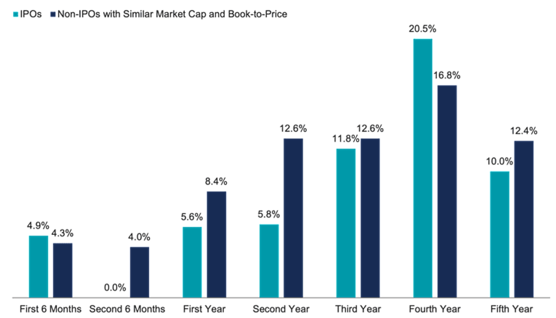
Disclosure: Data from 1/1/1980 – 12/31/2024. Past performance is no guarantee of future results.
Source: Jay Ritter, “Initial Public Offerings: Updated Long-Run Statistics,” Warrington College of Business, University of Florida, March 23, 2026. (https://www.avantisinvestors.com/avantis-insights/mega-ipos-investor-guide/)
Additionally, as shown in the return analysis below, a hypothetical portfolio of IPOs has historically trailed the broader U.S. market, as measured by the Russell 3000 Index, with greater volatility. This reinforces the case for thoughtful sizing and diversification when investing in newly public companies.
Figure 2: IPO Returns Analysis

Disclosure: The sample includes U.S. market IPOs, including U.S.-domiciled companies and foreign-domiciled IPOs in the U.S., with an offering date between January 1, 1991, to December 31, 2024. Excluded from the sample are IPOs with an offer price below $5, unit IPOs (common stock and warrants), and IPOs involving real estate investment trusts, closed-end funds, American depository receipts, partnerships, and acquisition companies. The hypothetical IPO portfolio is formed December 31, 1991, and is rebalanced monthly to include all firms with an IPO during the prior 12-month period. Weights are based on prior month-end market capitalization. Frank Russell Company is the source and owner of the trademarks, service marks, and copyrights related to the Russell Indices. Indices are not available for direct investment; therefore, their performance does not reflect the expenses associated with the management of an actual portfolio. The results above are based on a hypothetical portfolio and are provided for illustrative purposes only. They do not reflect actual client performance.
Source: Dimensional using Bloomberg data.
What History Tells Us About IPOs
One reason IPOs may underperform is that many newly public companies are not yet profitable. Companies with lower profitability have historically exhibited lower expected returns than more profitable companies with otherwise similar characteristics. This underscores why IPO exposure should be approached thoughtfully within a diversified portfolio.
Figure 3: A High Percentage of IPOs are Unprofitable
Percentage of U.S. IPOs with negative trailing 12-month earnings

Disclosure: Data from 1/1/1980 – 12/31/2025. Past performance is no guarantee of future results.
Source: Jay Ritter, “Initial Public Offerings: Updated Statistics,” Warrington College of Business, University of Florida, April 14, 2026. (link: https://www.avantisinvestors.com/avantis-insights/mega-ipos-investor-guide/)
Our Take
At Raffa, we believe investors do not need to choose between innovation and discipline. We believe it is reasonable for diversified portfolios to have exposure to newly public companies, since owning the broad market means participating in the ongoing evolution of the public markets.
At the same time, our strategy is to generally underweight newly public companies. This reflects the historical performance record of IPOs as a group, as well as the fact that many newly public companies have lower levels of profitability, shorter operating histories, and greater uncertainty than more established businesses.
Our approach is that IPO exposure should be sized thoughtfully within a diversified, evidence-based investment strategy. Even if a handful of IPOs become exceptional long-term winners, identifying those winners in advance is extremely difficult. Diversification allows investors to benefit from successful innovators while reducing reliance on any single company’s outcome.
Conclusion
The current IPO wave may introduce public investors to some of the more exciting companies of the coming decade. In our view, successful investing is not about being first. It is about maintaining a disciplined process that allows investors to participate in long-term growth while staying aligned with their goals and risk tolerance. Well-constructed portfolios can participate in innovation without requiring concentrated bets on a single company, theme, or headline.

Mark Murphy, CFA
Chief Investment Officer
Mark Murphy, CFA, is Chief Investment Officer at Raffa Investment Advisers and has more than 15 years of direct experience serving as an OCIO and lead portfolio manager for nonprofit organizations and membership associations. As Chief Investment Officer, Mark works closely with investment committees and staff to implement policy-driven investment programs designed to balance liquidity needs, risk management, and long-term financial sustainability. He is known for his disciplined approach, attention to detail, and ability to translate complex investment concepts into clear, committee-ready guidance.
Mark is an active participant in the nonprofit and association community and has spoken on governance, fiduciary oversight, and nonprofit investing for organizations including the Greater Washington Society of CPAs, the AICPA, BoardSource, and the American Society of Association Executives. He is a Chartered Financial Analyst (CFA) and holds a Bachelor of Science in Business Administration with concentrations in Accounting and Finance from the University of Richmond.
Disclosures:
This material is provided for informational and educational purposes only and does not constitute investment advice or a recommendation to buy or sell any security. The views expressed are those of Raffa Wealth Management, LLC dba Raffa Investment Advisers (“Raffa”) as of the date indicated and are subject to change without notice.
Investing involves risk, including the possible loss of principal. Past performance is no guarantee of future results. No assurance can be given that any investment strategy will be successful or achieve its objectives.
Certain information contained herein reflects historical data and may include references to broad market indices. Index performance is provided for illustrative purposes only, does not reflect the deduction of fees or expenses, and is not available for direct investment.
Any hypothetical, back-tested, or model-based results presented are for illustrative purposes only and do not represent actual client performance. Such results are based on assumptions that may not reflect actual market conditions or investor behavior and are subject to inherent limitations. Actual results may differ materially. These materials are not intended for use by, and may not be suitable for, all investors.
The information presented has been obtained from sources believed to be reliable; however, Raffa does not guarantee the accuracy, completeness, or timeliness of such information. Any forward-looking statements or expectations are hypothetical in nature and are subject to change.
This material is not intended as a substitute for personalized investment advice. Investors should consult with a qualified financial professional before making any investment decision, taking into account their individual objectives, financial situation, and risk tolerance.
For additional information about Raffa Investment Advisers, including a description of services and fees, please request a copy of our current Form ADV Part 2A.