
Investment Management for Individuals and Families
Your investment strategy should reflect the life you have built and the one you are still planning. We work with individuals and families focused on retirement, family priorities, and the people and causes they want their money to support.
Investment Management Tailored to Your Goals

What is your investment portfolio meant to do for you? For individuals investing for retirement, families investing to support long-term goals across generations, or donors investing to expand their charitable impact, the answer is more complex than simply the rate of return. Your investment strategy has to take into account when and how you will draw income, how taxes are managed across your accounts, your risk tolerance, and how the strategy adapts as your circumstances and goals change.
Our team works with individuals and families who have built long-term financial stability over their careers. Many of our clients work in the nonprofit sector or are individuals with a significant focus on charitable giving. We help our clients connect the pieces of their financial life into a coordinated investment strategy that moves with them as their goals, family, and tax situation evolve.
Common Investment Management Considerations for Individuals and Families
Investment management involves different considerations from one client to the next based on the individual or family’s financial situation. A few common considerations that our advisers work with our clients to address include:
Tax-Efficient Investing
Asset & Investment Selection
Risk Tolerance
Multi-Account Coordination
Investing for Retirement Income
Charitable Giving Strategy
Concentrated Position Management
Values-Based Investing
Our Approach to Investment Management
Investment management is an ongoing process. Your portfolio is developed around your goals and financial situation at a specific moment in time and adjusted as your finances or future plans evolve. Our approach typically includes the following:
Getting to Know You and Understanding Your Goals
Onboarding includes your adviser taking the time to ask questions to gain a thorough understanding of your financial life, goals, risk tolerance, and the constraints that shape them. Topics your adviser may discuss with you include your assets, current and future income, spending, tax situation, retirement financial needs, family obligations, charitable intent, and any values or preferences you want reflected in how your money is invested. These conversations allow your adviser to understand what your portfolio is meant to support over the long term.
Developing a Goal-Aligned Strategy
Once your adviser has an understanding of your current financial situation, goals, and risk tolerance, they will work with you on a goal-aligned investment strategy. The strategy defines your target allocation mix, risk parameters, tax considerations, and a transition process to move from your current holdings to your new strategy. It guides the investment decisions made within your portfolio and is updated as your financial situation changes. Keeping your adviser apprised of any major life events helps them adjust your strategy as needed.
Asset Selection
Asset selection is the process of choosing the specific bonds, ETFs, and other investments that make up your portfolio. Our team takes an open-architecture approach, meaning we evaluate options across the open market rather than from a proprietary list or a parent company’s lineup. New investments are reviewed against documented criteria, including cost, performance consistency, manager tenure, tax efficiency, and fit within the broader allocation.
Monitoring and Rebalancing Your Portfolio
Portfolio monitoring is the ongoing practice of tracking how a portfolio is performing relative to its targets, watching for opportunities, and adjusting positions as conditions change. Allocation drift, tax-loss harvesting opportunities, distribution payments, and contribution activity are tracked as they happen. Rebalancing is triggered by predefined ranges set in the investment strategy rather than by the calendar.
Reporting and Ongoing Communication
Performance reports highlight your portfolio’s results against defined benchmarks and allocation against targets, so you can monitor progress over time. Advisers also send monthly market commentary and updates during significant market events. Communication frequency is structured around how often you wish to engage, and your adviser is available to meet as needed.
Coordination with Your Other Advisers
Many of our clients work with additional advisers such as CPAs and estate attorneys. Your investment adviser is able to coordinate with you and your other advisers to align your investment strategy with your tax strategy and estate plan. This coordination allows each strategy to work as part of a larger whole rather than in isolation.
Knowledge is Meant to be Shared
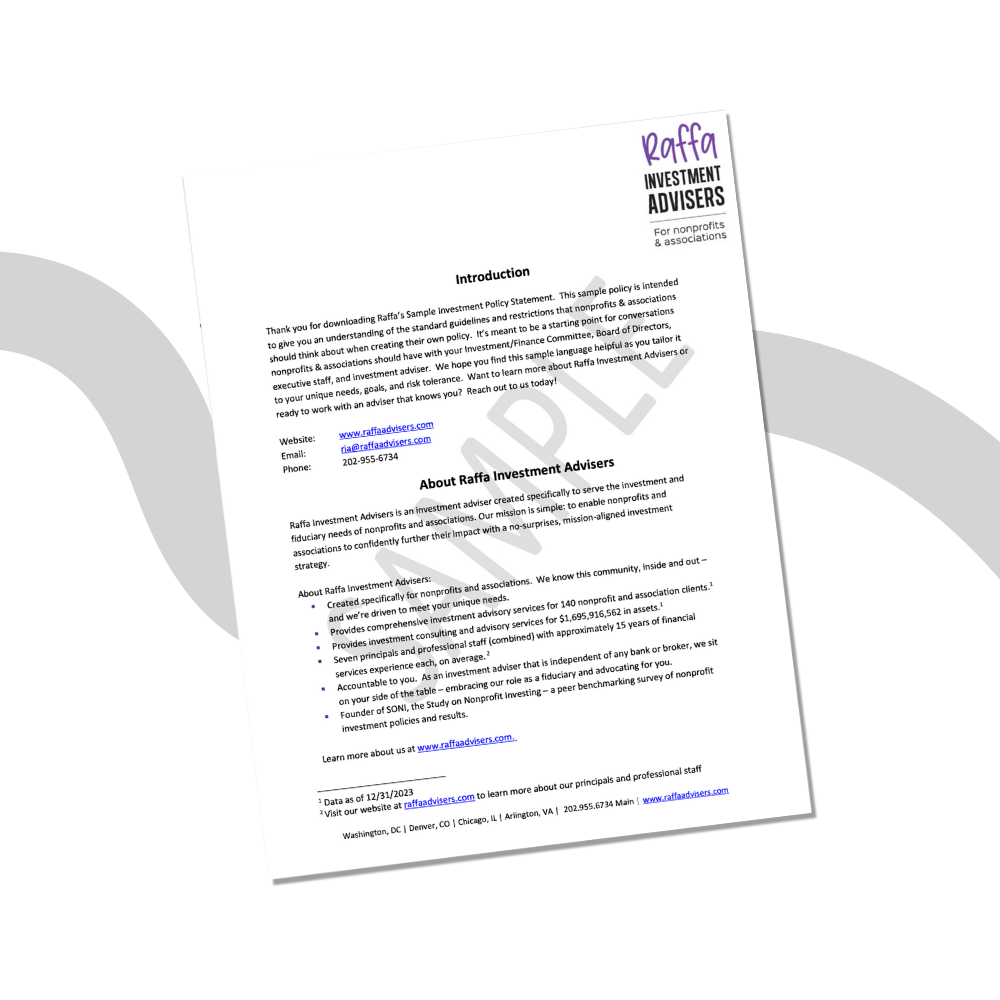
Raffa Insights & Resources


Frequently Asked Questions About Investment Management
What does an investment adviser do?
An investment adviser is typically responsible for the management and oversight of an investment portfolio on behalf of an individual, family, or organization. For individuals and families, this typically includes setting portfolio allocation, selecting investments, rebalancing, considering the tax impact of investment decisions, reporting on progress, and coordinating with other advisers such as a CPA or estate attorney. The result is a portfolio customized to the client’s financial situation and reviewed on a continuous basis.
What is a fiduciary investment adviser?
A fiduciary investment adviser is legally and ethically required to act in the client’s best interest, providing advice that prioritizes the client over the adviser’s own compensation. For individuals and families, working with a fiduciary investment adviser means recommendations are not driven by commissions, product sales, or revenue-sharing arrangements with fund companies. As a Registered Investment Adviser (RIA), Raffa is always a fiduciary to our clients.
What is tax-efficient investing?
Tax-efficient investing means making investment decisions with attention to the taxes they generate, both in the near term and over the long term. Different investments are taxed differently depending on the type of income they produce (dividends, interest, capital gains) and the type of account they are held in (a taxable brokerage account, an IRA, or a Roth IRA). Tax-efficient investing also weighs your current tax bracket against where it may be in the future: someone in a higher tax bracket today might defer taxable income to a lower-bracket retirement year, while someone in a temporary lower-bracket year might recognize income now. Common strategies include holding tax-inefficient investments in tax-advantaged accounts, selling losing positions to offset gains (tax-loss harvesting), and gifting appreciated stock to charity instead of cash, all with the goal of keeping more of what your investments earn. While your investment adviser can consider how investments impact your overall tax burden, they are not a CPA. We recommend working with both your investment adviser and CPA together, to understand how your tax strategy and investment strategy correspond.
What is values-based or ESG investing?
Values-based investing is an approach that incorporates the investor’s specific preferences into investment selection. ESG (environmental, social, and governance) and SRI (socially responsible investing) are two of the most common frameworks. ESG generally evaluates companies on those three dimensions as part of investment analysis, while SRI typically excludes industries or activities that conflict with the investor’s values, such as tobacco or weapons manufacturing. Other examples include faith-based screens and mission-aligned investing. For individuals and families with strong views about how their money is invested, values-based options are evaluated alongside traditional considerations like cost, performance consistency, and tax efficiency.
Disclosures:
This webpage is provided for informational and educational purposes only and does not constitute individualized investment, legal, tax, or financial planning advice. The information presented is general in nature and may not be applicable to every individual or family. Investment management strategies, including those related to asset allocation, diversification, tax‑efficient investing, values‑based or ESG investing, and retirement income planning, involve risk and may not be suitable for all investors. There is no guarantee that any investment strategy will achieve its intended objectives or result in favorable investment outcomes. Past performance is not indicative of future results.
References to tax considerations, tax‑efficient investing, tax‑loss harvesting, or coordination with tax strategies are for general informational purposes only. Raffa Investment Advisers does not provide legal or tax advice. Clients and prospective clients should consult their independent tax and legal professionals regarding their specific circumstances. Coordination with other professionals, including CPAs and estate planning attorneys, is intended to facilitate communication and alignment of strategies, but Raffa Investment Advisers does not supervise or assume responsibility for the advice or services provided by unaffiliated third‑party professionals.
Values‑based, ESG, or socially responsible investing reflects client preferences and may limit investment options or cause performance to differ from strategies that do not apply such criteria.
Advisory services are provided only pursuant to an executed investment advisory agreement. Additional information about Raffa Investment Advisers’ services, fees, conflicts of interest, and risks is available in the firm’s Form ADV, which is available upon request or at adviserinfo.sec.gov.