
Sample Investment Policy Statement for Nonprofits and Associations
An investment policy statement is the board-approved document that guides how a nonprofit or association invests its reserves and how those investments are overseen. This sample is intended to help organizations as they work to strengthen an existing policy or develop a new one.
Creating an Effective IPS
An investment policy statement (IPS) is the governing document behind how a nonprofit or association invests its reserves. It defines the organization’s investment objectives and the level of risk it is prepared to accept, and it establishes the framework within which the portfolio is managed and reviewed. Once in place, it holds investment decisions to that standard, and it gives the board a consistent basis for overseeing the portfolio.
This sample investment policy template is intended to provide a foundation boards can shape around their own reserves and objectives.
Additional Investment & Reserve Policy Resources:
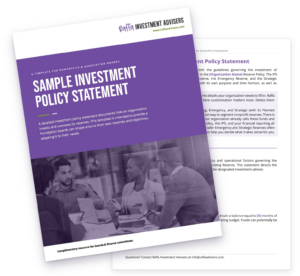
Download Our Nonprofit & Association Sample Investment Policy Statement
What an Investment Policy Statement Should Provide
Consistency
Investment decisions stay tied to the organization's objectives as markets move and board members change.
Oversight
The board has a defined standard to measure the portfolio against when it reviews results.
Accountability
Responsibilities for investing, monitoring, and reviewing the reserves are clearly assigned.
Fiduciary Care
The board has a documented basis for the investment decisions it makes on the organization's behalf.
What an Investment Policy Statement Includes
A detailed investment policy statement documents how an organization invests and oversees its reserves. The specifics vary from one organization to the next, but in general an investment policy statement addresses:
- What each reserve is for and what the organization aims to achieve by investing it
- The return the organization is aiming for over time
- When the organization expects to use the funds and what its cash needs are in the meantime
- Its tax status, which can affect the types of investments that are appropriate
- How much risk the organization is willing to take and the target mix of investments that reflects it
- How the portfolio is brought back to its target mix as markets shift
- The investments the portfolio may hold and any it should avoid
- The benchmarks the portfolio is measured against
- How the portfolio is monitored and how investment results are reported to the board
- Who is responsible for investing, monitoring, and overseeing the reserves
- How and when the policy itself is reviewed and updated
Looking for Help With Your Investment Policy Statement?
Raffa helps nonprofit and association boards create investment policy statements that reflect their objectives and governance needs. If you would like help reviewing or building yours, click the button below to schedule a meeting with one of our advisers or email our team at info@raffaadvisers.com.
Common Questions That Often Arise Regarding Nonprofit Investment Policies
How do you write an investment policy statement?
Writing an investment policy statement generally begins after an organization has defined its reserve policy, since the reserve policy sets how much the organization holds and how those funds are segmented. With that in place, the investment policy statement defines how each reserve is invested. A typical statement sets the purpose and objectives for each reserve, the time horizon and cash flow behind the funds, the level of risk the organization will accept, and the asset allocation that reflects it. From there it records eligible investments, benchmarks, and how the portfolio will be monitored. Most organizations draft it with input from the board or investment committee, and often an investment adviser, so the final policy reflects both the organization’s goals and how its reserves will be managed.
How should an investment policy statement address different reserve pools?
An investment policy statement generally addresses each reserve pool separately, setting objectives and an investment strategy for each. Organizations often hold reserves for different purposes, and each purpose can call for a different time horizon, level of risk, and asset allocation. By defining the objectives, allocation, and benchmarks for each reserve segment, the policy ties each pool’s investment approach to its purpose, and shared sections handle monitoring, roles, and how the policy is reviewed over time.
How is asset allocation set within an investment policy statement?
Asset allocation in an investment policy statement is generally set by matching the mix of investments to each reserve’s objectives, time horizon, and tolerance for risk. Funds needed in the near term are typically held in more conservative, liquid investments, while funds with a longer horizon can often carry more exposure to growth assets. The statement usually records a target allocation across asset classes, along with ranges the portfolio can move within, so the mix stays within intended limits as market values change. It also defines how and when the portfolio is rebalanced toward those targets.
What benchmarks should be included in an investment policy statement?
Benchmarks in an investment policy statement are generally chosen to reflect how each reserve is invested, giving the board a neutral reference point for whether the strategy added value. A common approach pairs asset class benchmarks, such as a broad equity or fixed income index, with a policy benchmark that blends those indexes to match the portfolio’s target allocation. Benchmarks work best when they stay consistent over time and change only when the IPS is formally updated, so results can be compared across full market cycles rather than judged in isolation. For more on choosing a benchmark that fits your portfolio, see our guide to investment benchmarks for nonprofits and associations.
How does an investment policy statement support a board's fiduciary duties?
An investment policy statement supports a board’s fiduciary duties by documenting a prudent, consistent basis for how the organization’s reserves are invested and overseen. Board members are generally responsible for managing the organization’s assets with care, and a written policy shows that investment decisions follow a defined process rather than individual judgment. It sets objectives and guidelines in advance, assigns responsibility for carrying them out, and gives the board a standard for reviewing results. Having this in place helps the board demonstrate that it is meeting its duty of care as it oversees the reserves.
Disclosures:
Raffa Investment Advisers is a registered investment adviser with the U.S. Securities and Exchange Commission. Registration does not imply a certain level of skill or training.
All investments involve risk, including the possible loss of principal. Past performance is not indicative of future results. Any forward-looking statements are based on current expectations and are subject to uncertainties.
This page is for informational purposes only and should not be construed as personalized investment advice. The sample reserve and investment policies and associated guide are provided as a starting point rather than as legal documents or as legal advice, and your organization is responsible for reviewing and adapting any policy it adopts with its finance committee, board, and appropriate advisers. The considerations described here reflect Raffa’s perspective as an investment adviser serving nonprofits and associations, and other advisers may weigh them differently.
Portions of this page were drafted with the assistance of AI tools and reviewed by Raffa Investment Advisers staff for accuracy and compliance.